
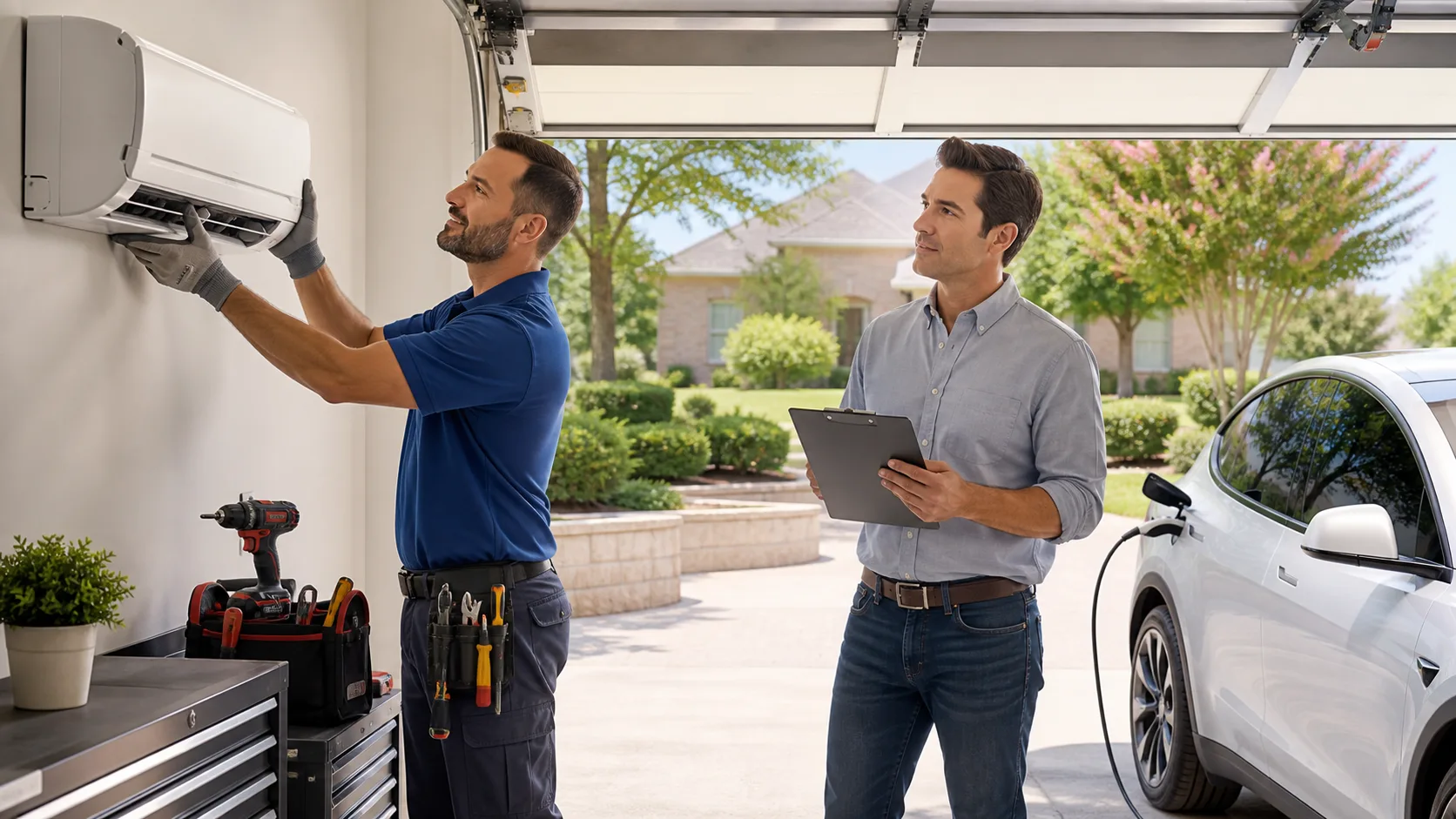
Make Your Addison Garage Work Year-Round
Turning the garage into real living and working space is getting more common around Addison. Many homeowners are turning that square footage into workshops, home gyms, EV charging bays, hobby rooms, or even small home offices. It is a smart way to get more use out of the home without a full addition.
The problem is that garages in our area swing from hot and humid in late summer to chilly in winter. That can make the space uncomfortable, hard on tools and finishes, and stressful for stored items. For EVs, extreme heat or cold can also be tough on batteries and charging gear.
In this article, we will walk through what actually drives the cost of garage cooling installation in Addison, how much energy different setups might use, and how the payback looks for a workshop, home gym, and EV charging focus. We will also touch on permits, HOA rules, and timing so your project goes smoothly.
What Drives the Cost of Garage Cooling in Addison
Garage cooling is more than just hanging a unit on the wall. A typical project can include:
- Equipment, like a ductless mini-split, small heat pump, or sometimes a ducted connection
- Electrical work for a new circuit, disconnect, or panel adjustments
- Insulation and air sealing that keep the cooled air in and hot air out
- Condensate drainage so moisture is carried away safely
- Labor to mount the indoor and outdoor units, run line sets, and start up the system
Garage size and shape matter. A 1-car garage with average ceilings is very different from a tall, 3-car space. A few key details that affect system sizing and difficulty are:
- 1-, 2-, or 3-car footprint
- Ceiling height and any loft or storage above
- How well the walls, ceiling, and garage door are insulated
- Whether the garage is attached, under living space, or fully detached
An attached 2-car garage with insulated walls and ceiling is usually simpler to condition than a detached building with thin walls and lots of air leaks. That impacts the type of system that makes sense and how much labor is involved.
Around Chicagoland, homeowners can expect a range of options, from basic, no-frills mini-splits to more efficient heat pumps with better comfort controls. While higher efficiency units can cost more upfront, choosing the right-sized, efficient setup is what sets the stage for better long-term ROI, especially if the garage is used several days a week.
Energy Use and ROI for a Workshop Garage
A common use is a 2-car garage workshop for woodworking, car projects, or DIY repairs. Many homeowners use this kind of space a few evenings a week plus weekends, mainly from May through September when garage temps can spike.
A typical 2-car workshop might need a modest system size, enough BTUs to keep the space comfortable even when outside air is hot and sticky. Once sized correctly, you can estimate:
- Monthly energy use based on how many hours per week you run cooling
- A lower energy draw for “moderate” use, like 10 to 20 hours per week
- A higher range for “heavy” use, like 30 hours or more each week
On a typical ComEd electric bill, that could mean a small bump for light, occasional use and a more noticeable increase for serious hobbyists who spend many hours in the garage. The exact number depends on system efficiency, set temperature, and insulation, so a professional load calculation is important.
ROI for a workshop is not just about the power bill. Cooling and dehumidification can:
- Help protect tools from rust and swelling
- Keep finishes, paints, and adhesives more stable
- Make long projects safer and more pleasant
- Add appeal if you ever sell the home with a finished hobby area
When garage cooling installation in Addison is planned with the actual use in mind, many homeowners feel the comfort and protection are worth the added energy cost.
Home Gym and EV Charging Payback Scenarios
A home gym in the garage sees different use patterns. Workouts may happen early in the morning, in the evening after work, and often throughout the year. Temperature control helps:
- Keep workouts safer, since exercising in extreme heat can be risky
- Make cardio and strength training more comfortable
- Protect rubber flooring, electronics, and metal equipment from moisture swings
Because a home gym may be used more often and in more seasons, annual energy use can be higher than a seasonal workshop. That is where a more efficient mini-split or heat pump can start to make sense, since frequent use magnifies the benefit of better efficiency.
For an EV-focused garage, the goal is a bit different. The priority is usually:
- Keeping the car and battery out of extreme heat or deep cold
- Making charging a bit more consistent by avoiding temperature extremes
- Reducing stress on charging cables and wall equipment
Here, you might run cooling less often, focusing on the hottest stretches and the coldest snaps. The “payback” is more about protecting your EV, which is a major investment, than about cutting the power bill. Even modest conditioning can help keep the space more stable compared to an untreated garage.
Comparing home gym and EV scenarios, a basic system may be fine if you only cool during the worst weather or charge mostly at night when temps drop. A higher SEER mini-split or heat pump is a better fit if:
- You exercise in the garage several days a week
- The space doubles as a daily-use workshop or hobby area
- You plan to heat the garage in winter too
Professional, fully insured installation backed by EPA 608 Universal certification helps make sure the system is set up correctly, which is important any time refrigerant and electrical work are involved.
Choosing the Right System Type for Your Garage
There are a few common system types for garages, each with pros and cons:
- Ductless mini-splits: Quiet, efficient, and flexible, great for workshops and gyms
- Standard heat pumps: Good when tied into existing ductwork or when both heating and cooling are needed
- Packaged or through-the-wall units: Simple and compact, often better for smaller or more basic setups
For a workshop or home gym that needs quiet comfort and good control, ductless mini-splits are often a strong choice. For an EV charging bay that just needs mild conditioning, a simpler through-the-wall unit might be enough if the layout and structure allow it.
Right-sizing is key in Addison because of hot, humid late summers and cold winters. If the system is too small, it will struggle. If it is too large, it may short-cycle and feel clammy. Higher efficiency ratings usually pay off when the garage is used most days of the week.
Professional design and installation matter. Proper refrigerant handling that aligns with EPA 608 Universal standards, correct electrical work, smart equipment placement, and reliable condensate management all protect your investment. For garage cooling installation in Addison, working with a contractor that also offers 24/7 emergency support adds peace of mind if something goes wrong at a bad time.
Permits, HOA Rules, and Timing Your Project Right
Garage cooling often needs permits, just like other mechanical projects. In Addison, that can include:
- Mechanical permits for installing new HVAC equipment
- Electrical permits if a new circuit or panel changes are needed
- Reviews of exterior condensers or wall units that face the street or neighbors
Local rules about noise and equipment placement can affect what type of unit is used and where it can sit. This can impact both cost and design.
If you are in an HOA or condo association, you may have extra layers of review. Common issues include:
- How visible the outdoor unit and line sets are
- Color and style of line set covers
- Where condensate drains, to avoid staining or ice patches
- Sound levels during early morning or late-night operation
Clear drawings, equipment specs, and proof of insurance from the contractor can help speed approval.
Timing also matters. Many people wait until a heat wave to think about cooling, but planning ahead often gives better scheduling and access to any seasonal promotions. It is especially helpful to complete projects tied to EV charging or sensitive equipment before the hottest or coldest weather, since those spaces may need reliable conditions right away. Having work done by a contractor with 24/7 capability can be a comfort if you rely on that garage space daily.
Turn Your Garage Into Comfortable, High-Value Space
When you cool and condition your garage, you turn it from storage into real, usable square footage. Workshops stay more comfortable, home gyms feel better, and EVs and equipment get a more stable environment. That can improve day-to-day life and may add appeal when it is time to sell.
Any Temp is a fully insured, EPA 608 Universal certified HVAC contractor based near Addison, and we focus on practical, ROI-minded solutions for garages and other residential spaces. A professional load calculation and use-based plan can help you compare a workshop, home gym, and EV-focused design so you pick the setup that fits how you actually live and work in your home.
Get Started With Your Project Today
If your garage is too hot to use comfortably, we can help you turn it into a cooler, more functional space. Our team at Any Temp specializes in professional garage cooling installation in Addison tailored to your home and budget. Reach out today so we can discuss your needs, answer your questions, and recommend the right solution. To schedule a consultation or request an estimate, simply contact us.